
Human Leukocyte Antigen Analysis
Human leukocyte antigen (HLA) molecules are highly polymorphic membrane proteins that play a central role in immune recognition and compatibility. In transplantation diagnostics, differences in HLA expression between donor and recipient can lead to immune rejection, making accurate HLA typing and crossmatch testing essential for successful outcomes. Advances in molecular methods such as next-generation sequencing (NGS) now enable high-resolution HLA genotyping and sensitive chimerism monitoring. These technologies allow laboratories to detect subtle genetic variations and monitor HLA chimerism or loss of heterozygosity (LOH), both of which can have critical implications for transplant success and relapse detection1,2.
In an era where virtual crossmatch and antibody profiling tools are expanding, physical crossmatch testing remains a vital and complementary tool for confirming donor-recipient compatibility3. º£½ÇÆƽâ°æ supports these workflows with reliable cell isolation and enrichment solutions that help your laboratory perform accurate, reproducible HLA analysis with confidence.
Below, explore a curated collection of educational resources that highlight best practices, innovations, and expert insights in HLA testing, crossmatch analysis, and chimerism monitoring.
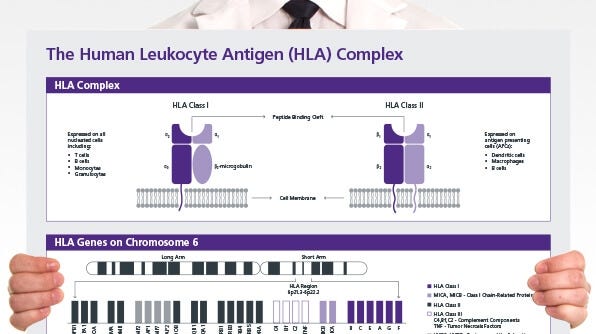
The Human Leukocyte Antigen (HLA) Complex
This wallchart provides an overview of the human leukocyte antigen (HLA) complex, HLA genes and nomenclature of HLA alleles.
Get Your Free Copy >- Nature Research Round Table: HLA Typing Considerations for Human Pluripotent Stem Cell BankingDr. David Turner from the Scottish National Blood Transfusion Service discusses immunological considerations around banking of human pluripotent stem cell (hPSC) lines for use in clinical trials. Dr. Turner’s work at the Histocompatibility and Immunogenetics (H&I) Laboratory involves donor-patient HLA-matching for clinical transplants. This presentation and the following Q&A session were moderated by Dr. Joanne Mountford from the University of Glasgow. <br><br> This presentation was part of a Round Table series titled “<a href="/nature-research-roundtable-hPSC-quality#section-webcasts">Challenges in Ensuring hPSC Quality</a>�, hosted in partnership with Nature Research. Global experts gathered at the Springer Nature headquarters in London, UK, to tackle some of the most pertinent issues impacting the use of human pluripotent stem cells (hPSCs), ranging from fundamental biology research to therapeutic applications. Explore the full series <a href="/nature-research-roundtable-hPSC-quality#section-webcasts">here</a>. <br><br> Note: Some original data from this presentation has been omitted to abide by copyright rules.

